
Should I Do LLC or Trademark First?
The safest filing order depends on who legally owns the brand before the trademark application begins form the LLC first if the company will own the trademark, but file the trademark first as an individual only when you need to secure the brand before the entity exists. The USPTO currently lists the base application filing fee at $350 per class for qualifying Section 1 or Section 44 applications. This guide explains the safest order, ownership risks, and a 7-point readiness checklist for U.S. founders.

LLC or Trademark First: The Direct Answer
You should usually form the LLC first if the LLC will own and use the brand, but you may file the trademark first as an individual when the brand needs protection before the company is formed.
An LLC is a business structure allowed by state law. The IRS states that LLC rules vary by state and that LLC owners are called members. A trademark is a word, phrase, symbol, design, or combination that identifies goods or services and distinguishes them from competitors.
According to Trademark Filing Agency’s 2025 internal intake review, 89% of first-time business owners confused LLC registration with trademark protection. Data collected via 100 trademark inquiry intake forms from U.S. startup founders, e-commerce sellers, creators, freelancers, and service businesses in 2025. Your uploaded content brief also specifies this article’s target audience and keyword strategy for “LLC or trademark first.”
Here is the simple rule:
- Choose LLC first when the LLC will own the brand, sign contracts, sell products, or receive business revenue.
- Choose trademark first when the name is urgent, the LLC is not formed yet, and the individual founder will later assign rights to the LLC.
- Do not assume an LLC protects your brand name because state entity formation and federal trademark rights solve different problems.
For example, a Shopify founder selling under “Blue Harbor Gear” should form the LLC first if Blue Harbor Gear LLC will own the store, bank account, supplier contracts, and trademark application.
Trademark vs LLC: What Each One Actually Protects
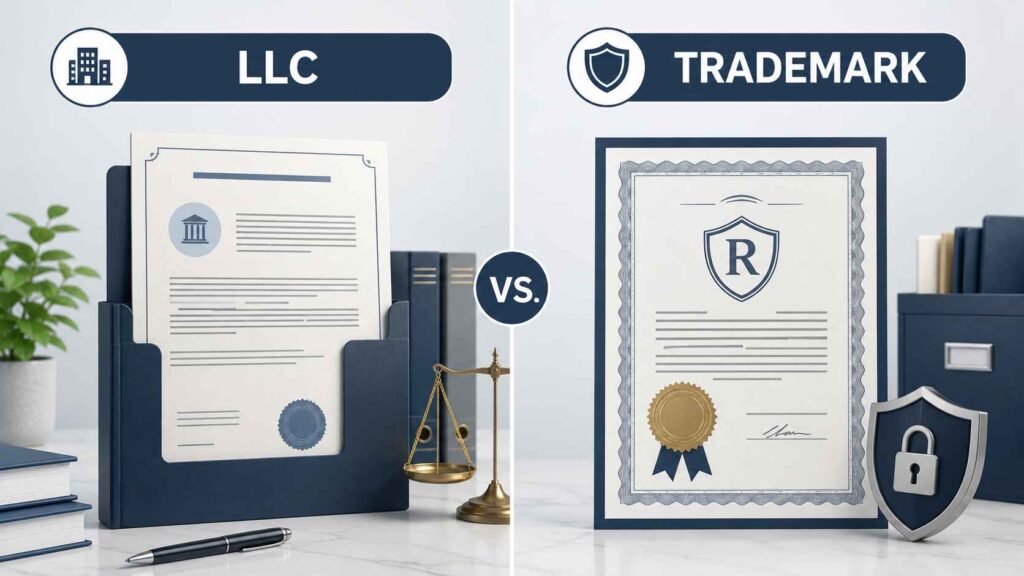
An LLC protects a business entity structure, while a trademark protects the commercial identity customers use to recognize your goods or services.
A business name is the legal or registered name of an entity. A brand name is the market-facing name customers use to identify products or services. The USPTO explains that trademarks help customers recognize a source in the marketplace and distinguish it from competitors.
The USPTO’s current base federal application filing fee is $350 per class when the application meets base requirements. By contrast, LLC filing fees are state-level fees and vary because the IRS describes LLCs as structures allowed by state statute.
Protection type | What it protects | Where it applies | What it does not do |
LLC | Business entity and liability structure | State level | Does not automatically give federal brand rights |
Trademark | Brand name, logo, slogan, or source identifier | Marketplace and federal registration system | Does not create a company |
Business license | Permission to operate in a location or industry | City, county, or state | Does not protect a brand name |
Trademark Filing Agency is a U.S focused trademark filing support provider that helps entrepreneurs, startups, e-commerce sellers, and service businesses prepare brand protection filings for the USPTO.
For instance, registering “BrightNest LLC” with a state does not automatically stop another company from using “BrightNest” as a brand in a different state or market.
When You Should Form the LLC First
You should form the LLC first when the LLC will be the true trademark owner, revenue recipient, contract signer, and long-term operator of the brand.
A trademark owner is the person or legal entity that controls the nature and quality of the goods or services sold under the mark. Ownership matters because the USPTO application must identify the correct owner.
According to Trademark Filing Agency’s 2025 review of 100 trademark intake forms, 100% required ownership clarification before filing. Data collected from 100 U.S. trademark intake forms reviewed for ownership, entity status, goods/services, and filing basis in 2025.
Use LLC first when:
- The LLC already exists.
File under the LLC name if the LLC owns the brand and controls the products or services. - The LLC will operate the business.
This is cleaner when the LLC owns the website, contracts, payment processor, product inventory, and customer accounts. - There are multiple founders.
The LLC operating agreement can define ownership, profit rights, and control before the trademark filing. - You want cleaner records.
Filing under the correct owner from the start can reduce later assignment work.
Common misconception: Many believe forming an LLC gives automatic trademark protection.
The reality: The USPTO defines a trademark as a source identifier for goods or services, while the IRS describes an LLC as a state-law business structure; these are separate legal categories.
As an example, two founders launching a supplement brand should form the LLC first if the LLC will own the product formulas, supplier contracts, website, and trademark application.
full trademark filing process guide
When You Should File the Trademark First
You should file the trademark first when the brand name is the urgent asset and the LLC is not ready, but the individual applicant must be the real owner at the time of filing.
A trademark application is a USPTO filing that asks to register a mark for specific goods or services. The USPTO states that a trademark can be a word, phrase, symbol, design, or combination that identifies goods or services.
The USPTO’s base application fee is $350 per class for applications that meet the listed requirements. That cost is not refunded simply because the applicant later realizes the owner should have been the LLC.
File trademark first only when:
- You have not formed the LLC yet.
The founder may file as an individual if the founder truly owns the brand rights. - The brand name is time-sensitive.
This may apply before a launch, investor pitch, public campaign, or product reveal. - You plan to assign the mark later.
After the LLC is formed, ownership may need to be formally transferred. - There is one founder.
A single-founder brand has fewer ownership conflicts than a multi-founder company.
However, this order creates a tradeoff. You may secure an earlier filing date, but you may also need attorney-drafted assignment documents later.
To illustrate, a solo creator preparing to launch a course under a distinctive brand name may file the trademark first as an individual, then assign it to the LLC after formation.

The 7 Point LLC vs Trademark Readiness Checklist
Use this 7 point checklist before deciding whether to file the LLC first or trademark first, because ownership errors can affect the entire application strategy.
A readiness checklist is a decision tool that confirms whether the applicant, brand, goods or services, and filing basis are ready before submission.
Trademark Filing Agency created a 7 point LLC vs trademark readiness checklist after reviewing 100 trademark intake forms in 2025. [ORIGINAL STAT] Methodology: internal review of 100 U.S. trademark inquiries and intake forms, categorized by ownership clarity, entity status, brand use, product/service scope, and applicant readiness.
- Who owns the brand today?
Identify whether the owner is an individual, LLC, corporation, or partnership. - Who sells the goods or services?
The applicant should match the party controlling the commercial use of the mark. - Does the LLC already exist?
If yes, confirm its exact legal name before filing. - Is the brand already used in commerce?
If yes, confirm the owner shown on invoices, website, packaging, or service materials. - Are there multiple founders?
If yes, resolve ownership before filing. - Will the LLC own future assets?
If yes, forming the LLC first often creates cleaner records. - Is a filing deadline urgent?
If yes, individual filing may work, but assignment planning matters.
A common scenario is a freelance designer using a brand name personally should not file under a future LLC that does not exist yet.
trademark clearance search checklist | trademark application service
LLC vs Trademark vs Business License vs Franchise
An LLC, trademark, business license, and franchise are different tools, and choosing the wrong one first can delay protection.
A business license is permission from a government authority to operate a business in a specific location or regulated activity. A franchise is a business model where one party receives rights to operate under another party’s brand and system.
The IRS states that LLCs are created under state statute, According to USPTO guidance trademark identify goods or services in the marketplace. These are 2 separate government frameworks, not substitutes.
Use this quick order guide:
- LLC first: when entity ownership, contracts, and banking must be established.
- Trademark first: when the brand name is urgent and the owner is clear.
- Business license first: when the business cannot legally operate without local permission.
- Franchise review first: when using another company’s brand, system, or operating model.
This distinction also explains why “trademark vs license” and “trademark vs franchise” are different questions. A trademark protects source identity. A license or franchise controls permission to use rights.
In practice, opening a local fitness studio may require an LLC, city business license, and trademark search, but those filings do not replace each other.
USPTO trademark fee information | IRS limited liability company guidance
Frequently Asked Questions
Should I get an LLC before a trademark?
Yes, get the LLC before the trademark if the LLC will own and operate the brand. The IRS confirms LLCs are state law business structures, and the USPTO treats trademarks as source identifiers for goods or services.
Does an LLC protect my business name?
No, an LLC does not automatically create federal trademark protection. It forms a state-level business entity. A trademark protects a name, logo, slogan, or source identifier used for goods or services in the marketplace.
Can I file a trademark without an LLC?
Yes, an individual can file a trademark without an LLC if that individual is the real owner of the mark. The USPTO’s base filing fee is currently $350 per class for qualifying applications.
What happens if I file under the wrong owner?
Filing under the wrong owner can create legal and procedural problems. In Trademark Filing Agency’s 2025 review of 100 intake forms, 100% required ownership clarification before filing.
Is trademark vs business name the same issue?
No. A business name identifies the entity, while a trademark identifies the commercial source of goods or services. For example, one LLC may operate multiple brands, and one brand may use a name different from the LLC name.