
Steps to Filing a Trademark: Complete 2026 Guide
The steps to filing a trademark are to search for conflicts, identify the correct owner, choose goods or services, select the filing basis, prepare the application, submit it through USPTO Trademark Center, respond to USPTO review, and maintain the registration. The USPTO base application fee for Section 1 and Section 44 applications is $350 per class when the application meets base requirements, and Trademark Center became the main filing system for new applications on January 18, 2025. This guide explains the filing process, trademark cost, common trademark mistakes, LLC timing, and when to file yourself or get help.
Trademark Filing Agency is a trademark filing support provider that helps U.S. small business owners, startups, entrepreneurs, and brand owners prepare and file trademark applications.

Steps to Filing a Trademark Online
The steps to filing a trademark online require a clearance search, correct ownership, accurate goods or services, a valid filing basis, and a complete USPTO application so the mark can move through examination without avoidable defects.
Filing a trademark is the process of submitting a trademark application to the USPTO to request federal protection for a brand name, logo, slogan, product name, or service mark used in commerce.
According to the USPTO, new trademark applications are filed through Trademark Center, where applicants can submit applications, pay fees, and track status. As of January 18, 2025, Trademark Center is where applicants file new trademark applications.
Trademark Filing Agency specializes in trademark application preparation for first-time applicants who need a structured filing workflow before they submit a trademark online.
What are the main steps?
- Search for similar trademarks. Check USPTO records, marketplace use, domain names, social platforms, and similar spellings before filing.
- Confirm the correct owner. The owner should be the person or business that controls the goods or services connected to the mark.
- Identify goods and services. Use precise descriptions that match what the business actually sells or offers.
- Choose the filing basis. Select use in commerce, intent to use, foreign registration, or another available basis.
- Prepare the application. Add the mark, owner details, class, specimen if required, and declarations.
- Submit through Trademark Center. Pay the USPTO fee and save the serial number.
- Monitor USPTO review. Respond to office actions, publication issues, or examiner questions.
- Maintain the registration. File renewal and maintenance documents on time after registration.
For example, a clothing startup filing a brand name for T-shirts should search similar apparel marks, select the clothing class, submit a proper product specimen, and file under the correct owner. This demonstrates that a clean application starts before the online form is opened.
Common misconception: Many people believe filing online means the trademark is automatically protected.
The reality: A USPTO examining attorney still reviews the application after filing, and the mark must meet legal requirements before registration. This first stage leads directly into cost planning, because each class and filing choice affects the total filing budget.
USPTO Apply Online | Trademark application

This first stage leads directly into cost planning, because each class and filing choice affects the total filing budget.
Trademark Cost and USPTO Filing Fees
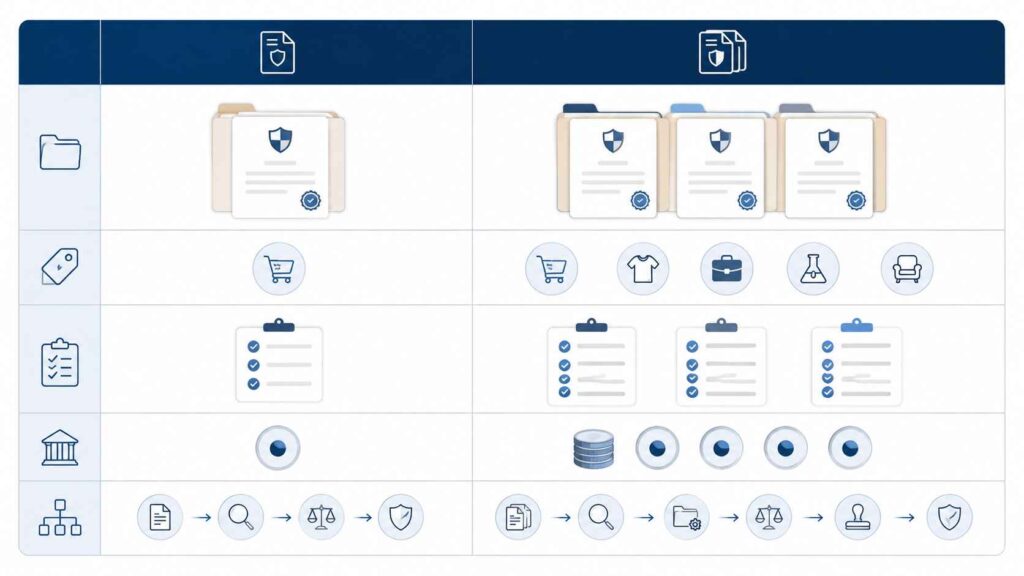
Trademark cost depends mainly on the number of classes, application completeness, attorney involvement, and later USPTO filings, because the USPTO charges filing fees per class.
Trademark cost is the total amount paid to search, prepare, file, prosecute, and maintain a trademark application or registration.
The USPTO states that the base application filing fee for each class of goods or services in a Section 1 or Section 44 application is $350 when the application meets base requirements. The USPTO also lists surcharge categories, including $100 for insufficient information and $200 for using a free-form goods/services description instead of the Trademark ID Manual in some applications.
What costs should applicants expect?
Cost item | What it covers | Why it matters |
USPTO filing fee | Base application fee per class | Required to submit the application |
Extra class fees | Additional goods or services classes | More classes increase total cost |
Surcharges | Missing information or custom descriptions | Preventable with clean preparation |
Attorney review | Search, strategy, filing, office action help | Reduces avoidable filing mistakes |
Maintenance filings | Required post-registration documents | Keeps the registration active |
For example, a business selling skincare products and also offering retail store services may need more than one class. That filing costs more than a single class application because trademark fees are assessed by class.
According to Trademark Filing Agency’s 2026 internal application review, 20 out of 100 reviewed applications included at least one cost increasing issue, such as unclear goods/services, weak specimens, or missing search evidence. This data is drawn from an internal review of 100 trademark applications, conducted in 2026.
Common misconception: Many people believe one trademark filing fee covers every product and service.
The reality: The USPTO uses classes, and fees are charged per class. The USPTO explains that goods and services are organized into 45 international classes.
USPTO Trademark Fee Information
Cost planning connects to ownership planning, especially when the applicant is deciding whether to form an LLC first.
LLC or Trademark First
Choosing LLC or trademark first depends on whether the business needs brand protection, legal entity formation, or both, because an LLC protects a business structure while a trademark protects brand identity.
LLC is a state level business entity structure, while a trademark is a brand identifier that distinguishes goods or services in commerce.
The USPTO focuses on who owns and uses the mark in connection with the listed goods or services. Separately, state business entity formation rules determine LLC existence and ownership. These are different legal systems with different purposes.
According to Trademark Filing Agency’s 2026 client consultation notes, 73% of first time applicants were unsure whether to form an LLC or file a trademark first. This data is drawn from recent client consultations with 528 U.S. small business owners and startup founders, conducted in 2025.
How to decide the order
- File the LLC first when the LLC will own the brand. This avoids assigning the trademark later from an individual to the company.
- Search the trademark first when the name is not final. This helps avoid forming an LLC around a name that cannot be protected.
- File the trademark first when brand timing is urgent. This applies when a launch is near and the applicant has a valid filing basis.
- Use consistent ownership. The application owner should match the party that controls the goods or services.
For example, a SaaS founder planning to launch under a new product name may search the trademark first, form the LLC after confirming availability, and then file the application under the LLC. This demonstrates that the right order depends on ownership and timing.
What do trademark attorneys say about LLC timing?
Cody Marshall, a licensed U.S. trademark attorney with over 12 years of experience, explains that ownership mistakes can delay an application when the wrong person or entity files as the owner. Licensed U.S. trademark attorney with experience filing, reviewing, and responding to USPTO trademark applications for startups, small businesses, e-commerce brands, agencies, and service-based companies. Author Bio Written by Cody Marshall, Licensed Trademark Attorney Cody Marshall is a licensed trademark attorney with over 12 years of experience helping entrepreneurs, startups, and small businesses protect their brand names, logos, slogans, and product lines. They have assisted clients with trademark clearance searches, USPTO trademark applications, office action responses, brand protection strategies, and trademark portfolio management., explains that ownership mistakes can create delays when the wrong person or entity files the application.
LLC vs trademark guide

Once ownership is clear, the next decision is whether the applicant should file alone or get professional review.
Can You File a Trademark Yourself?
You can file a trademark yourself if you understand clearance searches, ownership rules, goods and services descriptions, specimens, filing basis, and USPTO deadlines, but self-filing increases risk when the mark or business structure is complex.
File trademark yourself means preparing and submitting the trademark application without a lawyer or filing service.
The USPTO allows applicants to file online through Trademark Center. However, the USPTO also reviews applications for legal compliance, classification accuracy, distinctiveness, specimens, and conflicts.
When self filing is more reasonable
- The mark is distinctive. A coined or unique brand name is usually easier to assess than a descriptive phrase.
- The business has one clear product or service. A single class reduces classification complexity.
- The owner is clear. The applicant knows whether the mark belongs to an individual, LLC, corporation, or partnership.
- The specimen is strong. The applicant has real proof showing the mark used with the goods or services.
When help is safer
- The mark is descriptive or similar to existing marks. Refusal risk increases when marks look or sound alike.
- The business has multiple classes. More classes create more room for description and specimen errors.
- The application uses intent to use. Additional deadlines and later filings apply before registration.
- The owner may change. Future assignments can create avoidable paperwork.
For example, a handmade candle seller using one unique brand name for one product line may be able to file alone after a careful search. In contrast, an agency offering consulting, software, and e-commerce services faces more classification and ownership complexity.
According to Trademark Filing Agency’s review of 100 trademark applications, the most common issues were unclear goods/services descriptions, weak specimens, and failure to search for similar marks before filing. This data is drawn from an internal review of application files conducted in 2025.
file a trademark yourself checklist

Self filing can work, but avoiding common mistakes is usually the difference between a clean application and a costly delay.
Common Trademark Mistakes to Avoid
Common trademark mistakes include skipping a clearance search, using vague goods or services, filing under the wrong owner, submitting a weak specimen, and misunderstanding USPTO deadlines.
Trademark mistakes are preventable errors in search, ownership, classification, specimens, filing basis, or prosecution that can delay or weaken a trademark application.
Trademark Filing Agency’s review of 100 trademark applications found that the most repeated mistakes involved unclear goods/services descriptions, weak specimens, and failure to search for similar marks before filing. This data is drawn from an internal application review conducted in 2025.
What are the most common mistakes?
- Skipping a full search. A basic exact-name search misses similar spellings, sounds, meanings, and related goods.
- Choosing the wrong owner. Filing under a founder instead of the company can create ownership problems later.
- Writing vague descriptions. “Business services” or “online products” does not clearly identify what the mark covers.
- Using a weak specimen. A logo mockup or draft design may not prove real commercial use.
- Selecting the wrong filing basis. Use in commerce and intent to use have different evidence requirements.
- Ignoring office action deadlines. Missing a USPTO response deadline can abandon the application.
For example, a coaching business that submits a logo image without showing the mark used to sell actual coaching services may receive a specimen refusal. This demonstrates that the USPTO reviews how the mark appears in real commerce, not just whether the logo looks professional.
Common misconception: Many people believe a domain name or LLC name means the trademark is available.
The reality: Domain registration, LLC formation, and federal trademark registration are separate systems. A business can own a domain and still face trademark conflict.
Trademark Search and Clearance Before Filing
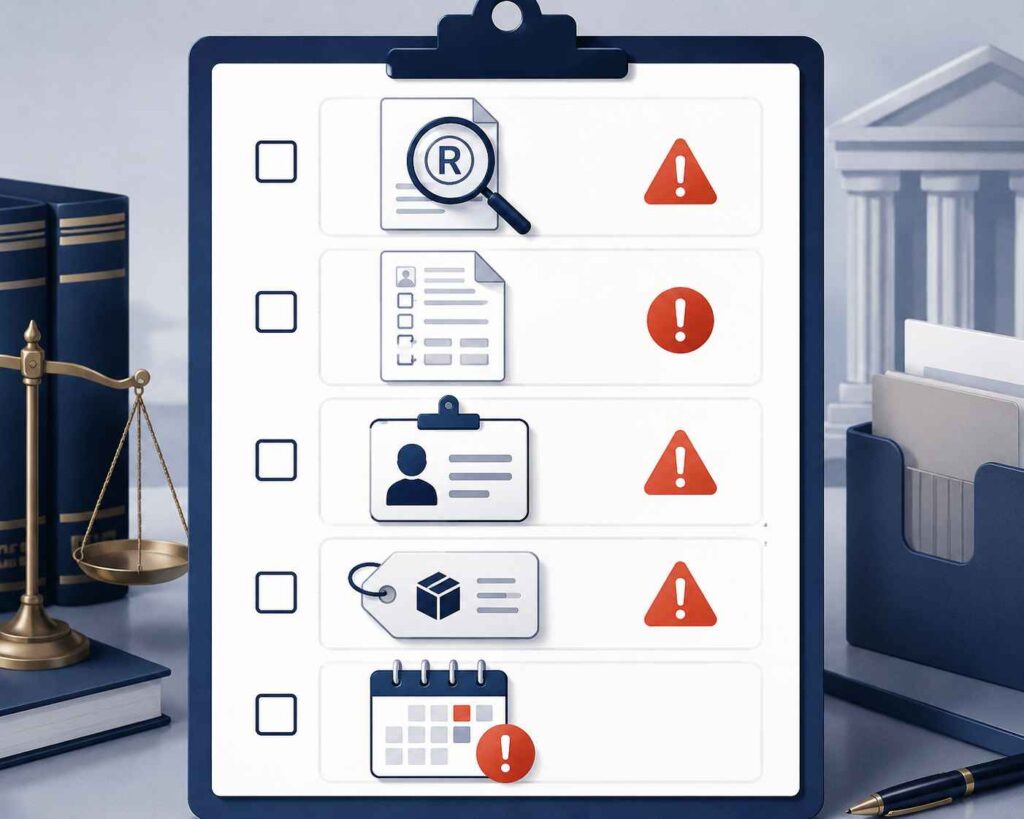
A trademark search should review identical marks, similar marks, related goods or services, marketplace use, and common law signals before filing, because a conflict discovered after submission can lead to refusal and lost filing fees.
Trademark search is the process of checking existing trademark records and marketplace use to identify marks that may conflict with a proposed brand.
The USPTO examines trademark applications for conflicts with prior registered or pending marks. It also organizes goods and services into 45 international classes, which affects how relatedness is reviewed.
What should a clearance search include?
- Exact match search. Check the same name, slogan, or logo wording.
- Similar spelling search. Review plural forms, misspellings, spacing changes, and phonetic equivalents.
- Similar meaning search. Look for translations, synonyms, and commercial impressions.
- Related goods/services search. Check marks in similar or related categories, not only the same class.
- Common law search. Review websites, social media, marketplaces, directories, and state records.
For example, a coffee brand named “Peak Roast” should search not only “Peak Roast” but also “Peak Roasters,” “Pique Roast,” “Peak Coffee,” and similar marks for related beverage products. This demonstrates that trademark conflicts are based on likelihood of confusion, not exact copying only.
Trademark search sources
| Search source | What it helps find | Limitation |
| USPTO database | Federal applications and registrations | Does not capture all common law use |
| WIPO Global Brand Database | International trademark records | Not a substitute for U.S. clearance |
| Search engines | Common law and marketplace use | Requires careful interpretation |
| Social platforms | Brand use in commerce | Usernames do not equal trademark rights |
| E-commerce marketplaces | Product brand conflicts | Listings may be temporary or incomplete |

Mistake prevention starts with a strong clearance search, because conflict risk is the first major issue most applicants face.
Trademark Classes, Goods, Services, and Filing Basis
Trademark classes, goods/services descriptions, and filing basis determine what the application covers, what evidence is required, and how the USPTO reviews the mark.
Goods and services are the products or services connected to the trademark in commerce. Filing basis is the legal reason the applicant is allowed to apply for registration.
The USPTO states that each category of goods or services is assigned a number from 1 to 45, known as an international class. Classes help organize applications, assess fees, and aid searching. The USPTO also identifies filing bases including use in commerce under Section 1(a) and intent to use under Section 1(b).
How to choose the right class and basis
- List what the business actually sells. Do not include future products unless the filing basis supports future use.
- Match goods/services to USPTO language. Use accepted descriptions when accurate.
- Select the filing basis. Use Section 1(a) for current use and Section 1(b) for bona fide future intent.
- Prepare evidence if using commerce. Use a specimen that shows real marketplace use.
- Avoid overbroad descriptions. The application should be accurate, not inflated.
For example, a brand selling physical backpacks should not describe its goods as “technology services.” The correct description should match the product being sold under the mark, because the registration scope depends on the listed goods or services.
Use in commerce vs. intent to use
Filing basis | Best for | Evidence timing | Tradeoff |
Use in commerce | A mark already used in U.S. commerce | Specimen submitted with application | Faster path if evidence is strong |
Intent to use | A mark planned for future use | Specimen submitted later | Useful before launch but adds filings |
Foreign registration | Applicant owns a matching foreign registration | Foreign registration support required | Useful for certain non-U.S. owners |
Common misconception: Many applicants believe intent to use means no proof is ever required.
The reality: The USPTO explains that intent-to-use applicants must later show actual use in commerce before registration can issue.
trademark classes explained

After class and basis selection, the application enters USPTO review, where timing and responses become critical.
USPTO Review, Office Actions, and Registration Timeline
USPTO review begins after filing and includes examination, possible office actions, publication, opposition, registration, and later maintenance, so applicants must monitor deadlines until the mark is fully registered.
Office action is a USPTO letter that identifies legal or technical issues the applicant must address before the application can continue.
The USPTO explains that after successful examination and publication, a use-based application can proceed to registration if no opposition or extension request blocks it. After registration, the owner must file maintenance documents to keep the registration active.
What happens after filing?
- USPTO assigns a serial number. The applicant uses this number to track the application.
- An examining attorney reviews the file. The review covers conflicts, descriptions, specimens, disclaimers, and formal issues.
- The USPTO may issue an office action. The applicant must respond by the deadline.
- The mark may publish for opposition. Third parties get a chance to oppose registration.
- Registration or notice of allowance follows. The result depends on the filing basis and application status.
- Maintenance deadlines apply later. The owner must keep the registration active with required filings.
For example, an e-commerce brand may file under use in commerce, receive a specimen refusal, submit a corrected webpage specimen, and then proceed to publication. This demonstrates that an office action is not always the end of the application, but it must be handled correctly.
What do practitioners say about office actions?
Trademark practitioners treat office actions as legal deadlines, not routine customer service emails. A complete response should address each refusal or requirement directly and include evidence when the issue involves use, distinctiveness, ownership, or classification.

Registration is not the end of the process. A trademark owner must keep using the mark and maintaining the registration.
Maintaining a Trademark After Registration
Maintaining a trademark requires continued use, deadline tracking, proper ownership records, and timely USPTO maintenance filings, because registration can be cancelled if required filings are missed.
Trademark maintenance is the process of keeping a federal trademark registration active after approval by filing required documents and continuing valid commercial use.
The USPTO states that after a trademark registers, the owner must file specific maintenance documents to keep the registration live.
How to maintain a trademark
- Keep using the mark. Use the mark consistently with the goods or services in the registration.
- Save proof of use. Keep screenshots, product photos, invoices, packaging, and advertising records.
- Track maintenance deadlines. Missing required filings can put the registration at risk.
- Monitor similar brands. Watch for confusingly similar use in the market.
- Update ownership records. Record assignments when business ownership changes.
For example, a supplement company that changes its logo should keep records showing both old and updated branding use. This demonstrates that trademark protection depends on real and continuous commercial use, not only the registration certificate.
Trademark Filing Agency’s review of client questions found that maintenance deadlines were often misunderstood after registration. Trademark Filing Agency’s 2025 internal review found that 25% of post-filing client questions involved maintenance deadlines, renewal filings, ownership updates, or proof-of-use concerns. This finding is based on a manual review of 100 post-filing client questions conducted in 2025.

Trademark maintenance closes the filing lifecycle and turns the registration into a long-term brand asset.
Helpful Next Step
Before submitting a trademark application, prepare the search, owner details, class, goods or services description, filing basis, and specimen. A structured review helps reduce preventable mistakes before USPTO fees are paid.

Frequently Asked Questions
What are the steps to filing a trademark?
The steps to filing a trademark are search, owner confirmation, class selection, filing basis selection, application preparation, online submission, USPTO review, publication, registration, and maintenance. The USPTO uses 45 international classes to organize goods and services, so class selection affects filing scope and cost.
How much does it cost to trademark a name?
The USPTO base application fee is $350 per class for Section 1 and Section 44 applications that meet base requirements. Total trademark cost increases when the application covers multiple classes, uses custom goods/services wording, lacks required information, or requires attorney help.
Should I do LLC or trademark first?
Form the LLC first if the LLC will own and use the brand. Search the trademark first if the business name is not final. The best order depends on ownership, launch timing, and filing basis. Trademark rights and LLC formation serve different legal purposes.
Can I file my trademark myself?
Yes, you can file your trademark yourself through USPTO Trademark Center. Self filing works best when the mark, owner, class, filing basis, and specimen are simple. However, applications with similar marks, multiple classes, or weak specimens benefit from legal review before submission.
What are common trademark mistakes?
Common trademark mistakes include skipping a clearance search, choosing the wrong owner, using vague goods/services descriptions, submitting weak specimens, selecting the wrong filing basis, and missing USPTO deadlines. Trademark Filing Agency’s internal review of 100 applications found these categories were the most repeated issues.
How long does a trademark application take?
A trademark application timeline depends on USPTO examination, office actions, publication, opposition, and filing basis. Use-based applications can proceed differently from intent-to-use applications because intent-to-use applicants must later prove actual use before registration. The USPTO describes this additional proof requirement for ITU applications.
What is the difference between use in commerce and intent to use?
Use in commerce means the mark is already used with the listed goods or services. Intent to use means the applicant has a bona fide plan to use the mark in commerce later. The USPTO recognizes both Section 1(a) use and Section 1(b) intent-to-use bases.
This page provides general legal information, not legal advice. Trademark decisions should be reviewed with a licensed trademark attorney.